
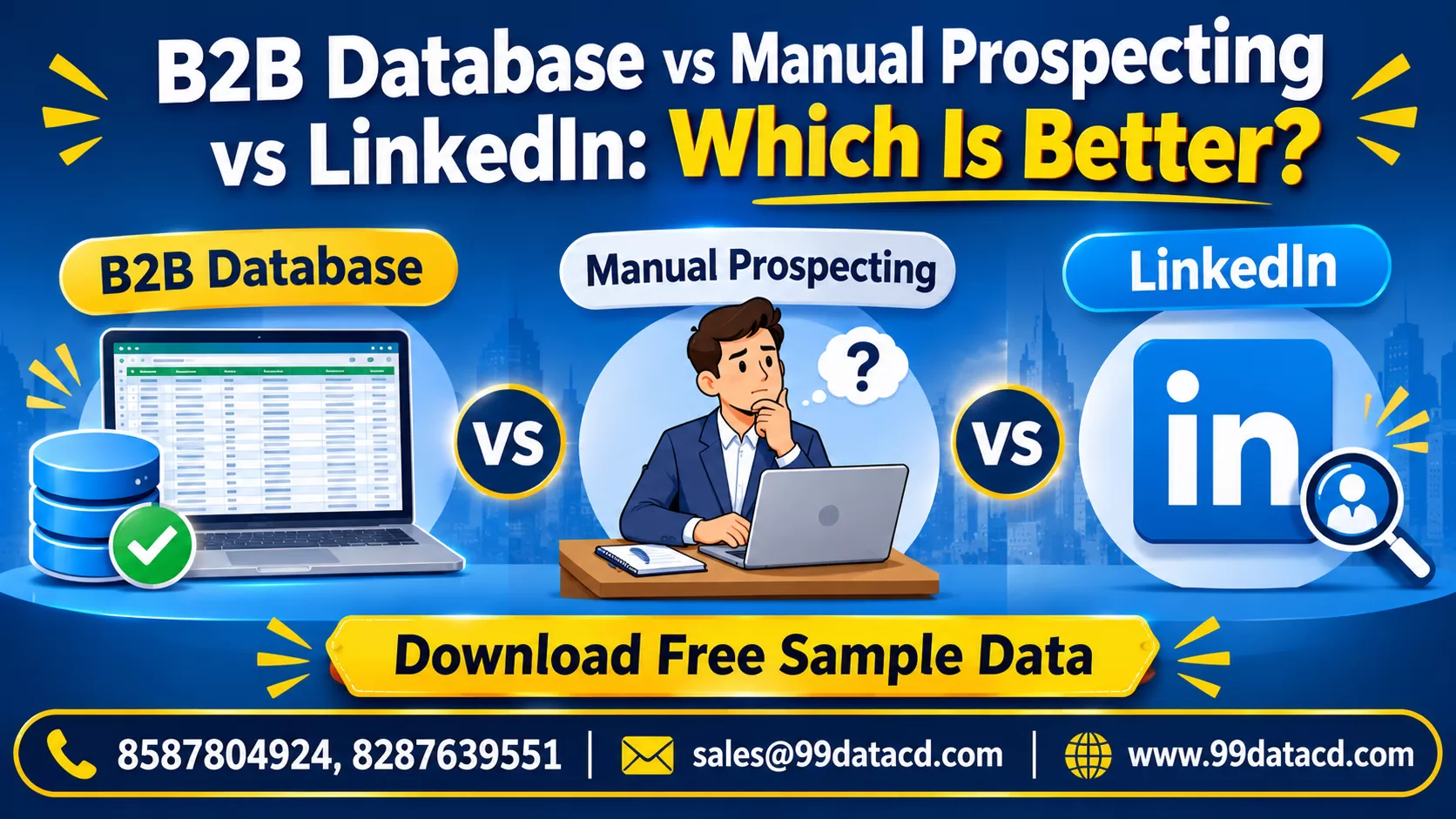
You have a product / service to sell and a target to hit. But before the first call, you face a choice that decides how your next few weeks will go: how do you find your prospects?
Some people or the marketing team search Google and directories by hand. Some live on LinkedIn. Others buy a ready-made B2B database India. Each B2B lead generation method has fans, and each has real limits. Here is an honest comparison to help you pick, or combine, the right one.
Quick Answer: Which is Better? (B2B database vs manual prospecting vs LinkedIn)
There is no single winner. Each one is best at a different job.
- B2B database: best for speed and volume.
- LinkedIn: best for reaching decision-makers and building relationships.
- Manual prospecting: best for small, very specific niches
Most of the teams get the best results by combining them. We explain how below.
Side-by-Side Comparison
| Better for | B2B Database | Manual Prospecting | |
|---|---|---|---|
| Speed | Fast, you can start the same day. | Medium | Slow |
| Scale | Thousands of contacts in one file. | Limited by search and messaging limits | Hard to scale |
| Phone and email | Usually included | Rarely visible | Sometimes, if you find them |
| Decision-maker targeting | Depends on the data fields | Strong, you can search by job title. | Depends on your research |
| Cash cost | One-time purchase | Free or paid plans | Free |
| Time cost | Low | Medium to high | High |
| Accuracy | Varies by provider; test first. | Profiles can be outdated too. | Good for the few contacts you check |
| Best for | Volume outreach by industry or city. | Corporate and senior contacts | Niche or high-value accounts |
Method 1: Manual Prospecting
This means searching Google, Google Maps, trade directories, association lists, and exhibition pages, then copying details into a sheet. So this is the manual prospecting vs B2B database comparison.
Where it works well?
- Very small or specific niches
- High-value accounts where you want to research each company
- You have more time than budget
Where it struggles?
- It is slow. Finding contacts for even a few hundred companies can take days.
- Phone numbers and emails are often missing or hard to find.
- It is hard to keep a consistent format across sources.
Manual research costs no money, but it costs time, and time is often your most limited resource.
Method 2: LinkedIn
LinkedIn lets you search by job title, company, industry, and location, which makes it excellent for finding the right person inside a company. So this is the method of LinkedIn lead generation in India.
Where it works well?
- Reaching managers, directors, and founders
- Building trust through profile views, comments, and connections
- Researching a company before you call
Where it struggles?
- Phone numbers and emails are usually not public.
- Connection requests and messaging have limits, and sending too many can restrict your account.
- Many small- and mid-sized Indian businesses, like local factories, traders, and dealers, are not active there.
- It is slower for volume outreach.
LinkedIn is a great relationship tool, but a weak bulk-list tool.
Method 3: B2B Database
A B2B database is a ready-made, organized list of companies with details like company name, address, phone, email and website, usually in Excel.
Where it works well?
- You want to reach many businesses in a trade or city quickly
- You plan to use calls, email, and WhatsApp together
- You want to filter by city, product, or business type
- Your buyers include small and mid-size firms that are not on LinkedIn
Where it struggles?
- Quality varies a lot between providers.
- No database is 100% accurate, because businesses change numbers and offices.
- You must follow rules on calls, SMS, and data protection.
A database gives you the list. You still need a good message and good follow-up.
Which Should You Choose? A Quick Guide
| Your situation | Best choice |
|---|---|
| You sell to many small and mid-size businesses across cities. | B2B database |
| You sell expensive solutions to corporate decision-makers. | LinkedIn, plus an email or mobile number database. |
| You target a handful of big accounts. | Manual research plus LinkedIn |
| You are launching in a new city or state. | B2B database |
| Your budget is very small, and you have time. | Manual prospecting |
| You want the best overall results. | A combination of all three |
The Combination Workflow That Works
- Build the base with a database. Filter by industry and city, and pick 200 to 300 companies for your first batch.
- Find the decision-maker on LinkedIn. For your top accounts, look up the right person and note the name.
- Verify manually. For high-value companies, check the website or call the front desk to confirm details.
- Reach out on two channels. For example, a call followed by a WhatsApp message or email.
- Follow up and track. Wait three to five days, follow up, and note replies and orders for each batch.
These are the best way to find B2B leads in India, the database gives you speed, LinkedIn gives you the right person, and manual checking gives you accuracy where it matters most.
How to Judge the True Cost?
Do not compare only the price. Compare the cost of your time too. Here is a simple way to think about it:
Total cost = money spent + (hours spent × the value of an hour of your time)
For example, if building a list by hand takes a week of your team’s time, that week has a cost, even though the sheet was “free.” Compare that with the price of a ready list plus a few hours of filtering.
If You Choose a Database: 5 Things to Check
- Is a B2B database worth it?
- Does it include the fields you need (phone, email, address, website)?
- Is it in Excel, so you can filter easily?
- Does the provider say where the data comes from and when it was updated?
- Is there a free sample you can test?
- Does it avoid promising “100% accuracy”?
Sample test: call 20 to 30 numbers from the sample and see how many connect and match the business name. That tells you more than any description.
Browse the full B2B database range to see what categories are available, or explore city and state-wise company data if you want to start with one location.
For more on narrowing your list, read How to Find B2B Leads in India: A Complete Guide.
Use Data Responsibly
Whichever method you use, contact businesses only for genuine B2B reasons. Follow telecom rules for calls and SMS (including DND), respect data protection law, stop contacting anyone who asks, and never use consumer (B2C) data for business outreach. This is general information, not legal advice.
Frequently Asked Questions (FAQs)
1. Is a B2B database better than LinkedIn?
B2B database vs LinkedIn: They do different jobs. A database is better for volume and for getting phone numbers and emails. LinkedIn is better for finding the right person and building trust. Many teams use both.
2. Is manual prospecting still worth it?
Yes, for small niches and high-value accounts. For large-scale outreach, it is usually too slow.
3. Can I rely only on LinkedIn for B2B leads in India?
It works well for corporate and senior contacts. But many small and mid-size Indian businesses are not very active there, and phone numbers are rarely visible.
4. How accurate are B2B databases?
No database is 100% accurate. Expect some wrong numbers, and test a sample before buying.
5. Which is the cheapest method?
Manual prospecting costs no money but costs the most time. A database costs money once but saves hours.
Final Thoughts
The real question is not “which method is best?” but “which method fits my goal today?” Use business data when you need speed and reach, LinkedIn when you need the right person, and manual research when you need precision. Combine them, and your outreach gets faster and sharper.
Want to test the database route? You can request a free sample from 99Datacd, check the data quality yourself, and decide with no pressure to buy. Our data is updated for 2026, comes in Excel with lifetime validity, and carries 75% to 85% accuracy, so a quick sample test is always the smartest first step.